


About FLEX
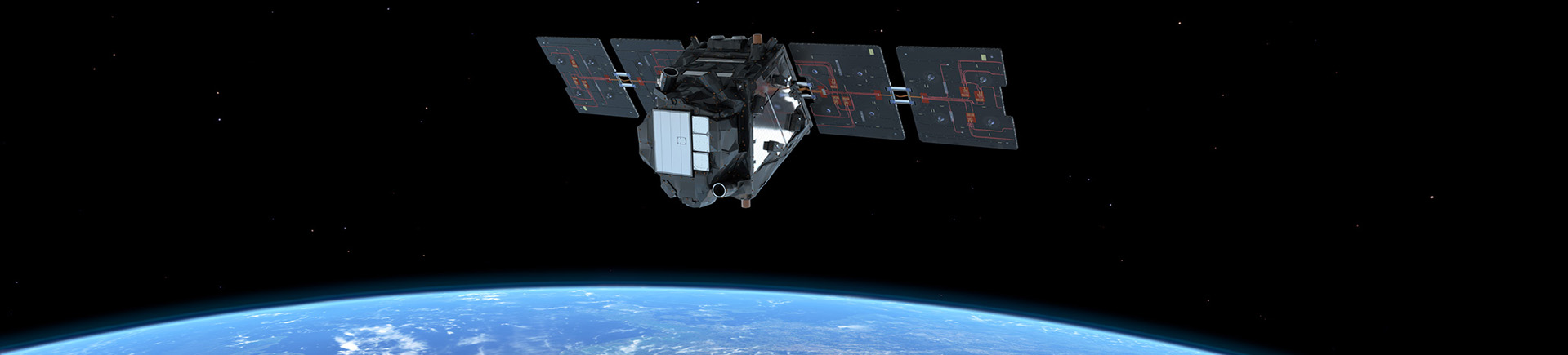
The FLuorescence EXplorer (FLEX) mission maps vegetation fluorescence to quantify photosynthetic activity.
By quantifying vegetation fluorescence, the photochemical reflectance index, the surface temperature, the FLEX mission concept provides the most innovative and unique set of measurements to increase our understanding of actual photosynthetic efficiency, and the status of vegetation health and plant performance, while addressing related societal challenges previously identified.
The information gathered will be used to improve our understanding of how carbon moves between plants and the atmosphere and how photosynthesis affects the carbon and water cycles.
Instrument
FLEX carries the high-resolution Fluorescence Imaging Spectrometer (FLORIS), which acquires data in the 500 – 780 nm spectral range. It has a sampling of 0.1 nm in the oxygen bands (759–769 nm and 686–697 nm) and 0.5–2.0 nm in the red edge, chlorophyll absorption and PRI (Photochemical Reflectance Index) bands.
The Launch
Date: September 2026
Site: Kourou, French Guiana
Rocket: Vega-C
Latest News

With the launch of ESA Earth Explorer’s FLEX on 15 September 2026, scientific understanding of plant photosynthesis, vegetation health, and carbon uptake is set to significantly improve. The satellite features the innovative FLORIS instrument, specifically designed to measure the faint fluorescence emitted by plants and provide global observations of photosynthetic activity.
The data collected will be crucial for enhancing our understanding of the global carbon cycle, improving ecosystem monitoring, and supporting agricultural and food-security applications.
More details are available at: ESA FLEX and Sentinel-3C launched .